
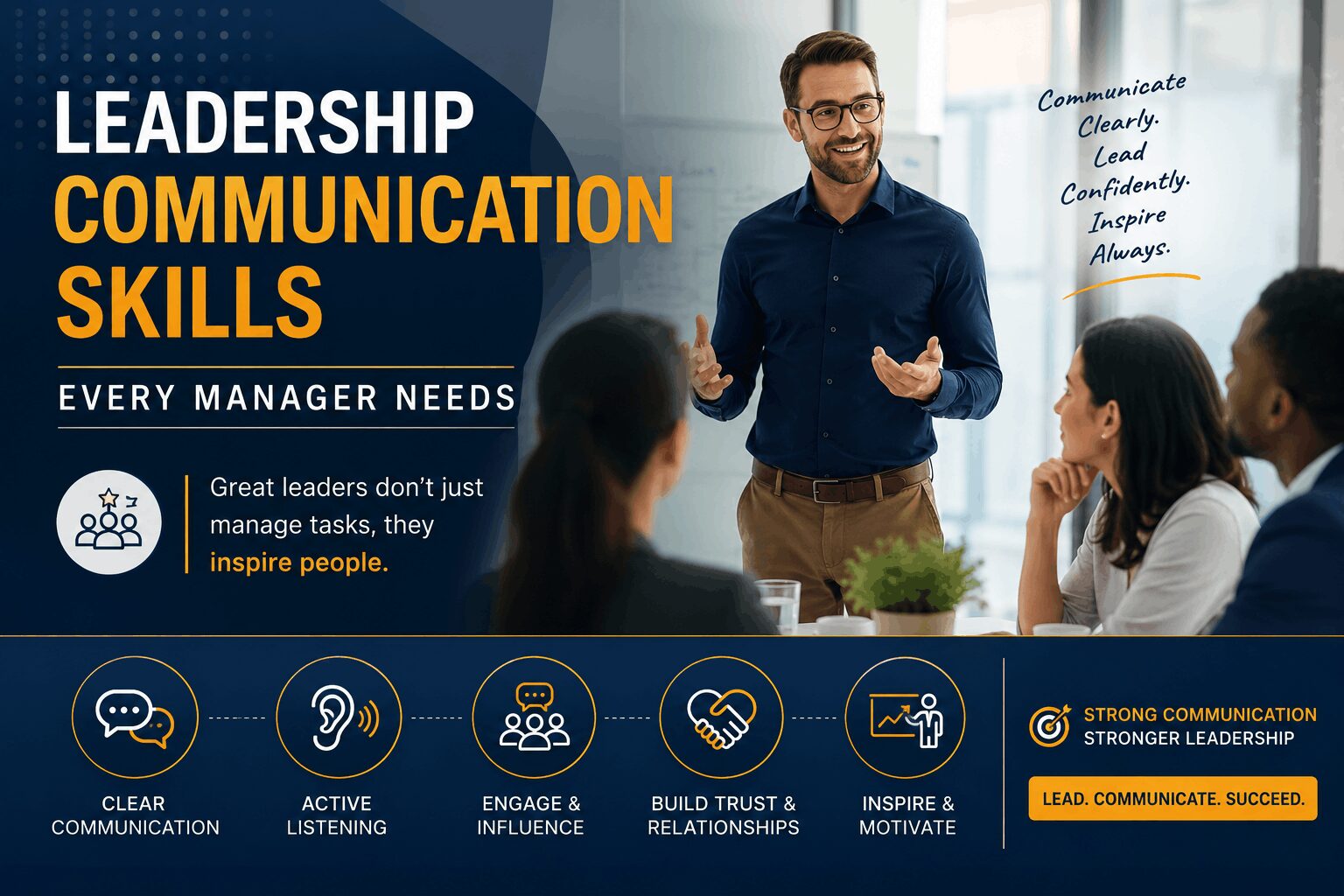
Leadership is no longer just about making decisions and managing teams. In today’s workplace, the ability to communicate effectively has become one of the most important skills a manager can possess. Whether you’re leading a small team, managing a department, or guiding an entire organization, your communication style directly impacts employee engagement, productivity, trust, and business performance.
Great managers do more than assign tasks they inspire action, build relationships, resolve conflicts, and create alignment through effective communication. Employees want leaders who can communicate clearly, listen actively, and provide direction with confidence.
In this guide, we’ll explore the leadership communication skills every manager needs to build stronger teams, improve workplace culture, and drive better results.
Quick Answer
Leadership communication skills are the abilities managers use to clearly convey ideas, inspire teams, provide feedback, resolve conflicts, and build trust. Effective leadership communication combines clarity, active listening, emotional intelligence, storytelling, and authenticity to create stronger employee engagement and organizational success.
Key Takeaways
- Strong communication is the foundation of effective leadership.
- Managers who communicate clearly improve team productivity and trust.
- Active listening is just as important as speaking.
- Emotional intelligence helps leaders navigate difficult conversations.
- Storytelling and authenticity make leadership messages more impactful.
Why Leadership Communication Matters
Communication influences every aspect of leadership.
When managers communicate effectively:
- Employees understand expectations.
- Teams collaborate better.
- Workplace conflicts decrease.
- Employee engagement increases.
- Organizational goals become clearer.
Research consistently shows that poor communication is one of the leading causes of workplace misunderstandings, low morale, and employee turnover.
Employees don’t leave companies they often leave managers who fail to communicate effectively.
Strong communication bridges the gap between vision and execution.
What Are Leadership Communication Skills?
Leadership communication skills refer to the verbal, non-verbal, written, and interpersonal abilities leaders use to influence, guide, motivate, and connect with others.
These skills help managers:
- Share organizational goals
- Provide feedback
- Build trust
- Manage change
- Resolve conflicts
- Inspire action
Unlike general communication, leadership communication focuses on influence, clarity, and relationship-building.
The LEAD Framework for Effective Leadership Communication
At The Power Speak, we recommend the LEAD Framework to help managers become stronger communicators.
L – Listen Actively
Great leaders spend more time listening than talking.
Active listening means:
- Paying full attention
- Avoiding interruptions
- Asking thoughtful questions
- Understanding before responding
Employees feel valued when they are genuinely heard.
Example
Instead of immediately offering solutions during a team discussion, a manager first asks:
“What challenges are you facing right now?”
This creates openness and trust.
E – Express Clearly
Clarity eliminates confusion.
Strong leaders communicate expectations, goals, and responsibilities in simple language.
Avoid:
- Corporate jargon
- Overly complex explanations
- Ambiguous instructions
Example
Instead of saying:
“We need to optimize our workflow.”
Say:
“We need to reduce project completion time by 20% over the next quarter.”
Specific communication drives better execution.
A – Adapt to Your Audience
Different people process information differently.
Effective managers adjust their communication style based on:
- Team members
- Stakeholders
- Executives
- Clients
A technical discussion with engineers should sound different from a motivational presentation to employees.
Adaptability improves understanding and engagement.
D – Demonstrate Authenticity
Authenticity builds credibility.
Employees trust leaders who are transparent, honest, and genuine.
Authentic communication involves:
- Admitting mistakes
- Sharing challenges
- Being consistent
- Speaking with sincerity
People follow leaders they trust.
Essential Leadership Communication Skills Every Manager Needs
1. Active Listening
Most communication problems begin when people stop listening.
Managers who actively listen gain valuable insights and strengthen employee relationships.
How to Improve
- Maintain eye contact
- Avoid multitasking
- Ask follow-up questions
- Summarize key points
Employees become more engaged when they feel heard.
2. Clear and Concise Communication
Complex messages often create confusion.
Effective leaders communicate in a way that everyone can understand.
Best Practices
- Use simple language
- Focus on key points
- Eliminate unnecessary details
- Confirm understanding
Clear communication saves time and prevents mistakes.
3. Emotional Intelligence
Emotional intelligence helps managers understand and manage emotions effectively.
This includes:
- Self-awareness
- Empathy
- Self-regulation
- Relationship management
Leaders with high emotional intelligence navigate difficult conversations more successfully.
Workplace Example
An employee misses a deadline.
Instead of reacting emotionally, the manager explores the underlying issue and collaborates on a solution.
4. Giving Constructive Feedback
Feedback is one of the most powerful leadership tools.
Great managers provide feedback that encourages growth rather than creating defensiveness.
Effective Feedback Formula
Situation → Observation → Impact → Improvement
Example:
“During yesterday’s presentation, several key data points were missing. This affected decision-making. Let’s work together to improve preparation for future meetings.”
Constructive feedback promotes accountability and development.
5. Storytelling
Facts inform, but stories inspire.
The best leaders use storytelling to make ideas memorable and emotionally engaging.
Stories help managers:
- Explain vision
- Share lessons
- Inspire action
- Build emotional connection
Example
Instead of presenting statistics about customer satisfaction, a manager shares a real customer success story.
Stories create stronger impact than data alone.
6. Conflict Resolution
Conflict is inevitable in every workplace.
Effective leaders address disagreements early and professionally.
Conflict Resolution Steps
- Listen to all perspectives
- Identify root causes
- Focus on solutions
- Encourage collaboration
- Follow up afterward
Strong communication transforms conflict into opportunity.
7. Public Speaking and Presentation Skills
Managers regularly communicate in:
- Team meetings
- Client presentations
- Training sessions
- Leadership briefings
Strong presentation skills increase influence and credibility.
Key Elements
- Confident delivery
- Structured messaging
- Audience engagement
- Clear call-to-action
The ability to speak confidently is a career-defining leadership skill.
8. Non-Verbal Communication
Communication goes beyond words.
Body language often influences how messages are perceived.
Important non-verbal signals include:
- Eye contact
- Facial expressions
- Posture
- Gestures
- Tone of voice
Leaders must ensure their body language supports their message.
Real-Life Example of Leadership Communication
Imagine two managers leading identical teams.
Manager A:
- Rarely listens
- Provides vague instructions
- Avoids feedback conversations
Manager B:
- Actively listens
- Communicates clearly
- Provides regular coaching
After six months:
- Team B demonstrates higher productivity.
- Employee engagement improves.
- Turnover decreases.
- Project performance increases.
The difference isn’t technical expertise.
It’s communication.
Common Leadership Communication Mistakes to Avoid
Talking More Than Listening
Communication is a two-way process.
Managers who dominate conversations miss valuable insights.
Using Too Much Corporate Jargon
Complex language often confuses employees.
Keep communication simple and practical.
Avoiding Difficult Conversations
Many managers delay addressing performance issues.
Timely communication prevents bigger problems later.
Inconsistent Messaging
Mixed messages create uncertainty.
Leaders should ensure consistency across all communication channels.
Ignoring Non-Verbal Signals
Employees often pay more attention to body language than words.
Ensure actions align with messages.
Expert Insight
According to The Power Speak team, the most influential leaders are not necessarily the loudest voices in the room. They are the individuals who communicate with clarity, empathy, and authenticity.
Leadership communication is not about speaking more; it’s about creating understanding, building trust, and inspiring meaningful action.
Organizations that invest in communication training often see improvements in employee engagement, leadership effectiveness, and overall business performance.
As founder Abhishek Mudgal emphasizes, powerful communication has the ability to transform workplaces, strengthen cultures, and create lasting impact.
Actionable Tips for Managers
Start Every Meeting with Clarity
Clearly define objectives and expected outcomes.
Practice Active Listening Daily
Listen to understand, not simply to respond.
Ask More Questions
Questions encourage participation and deeper insights.
Provide Regular Feedback
Don’t wait for annual performance reviews.
Invest in Public Speaking Skills
Confident communication increases leadership presence.
Use Stories to Inspire
People remember stories far longer than statistics.
Focus on Empathy
Understand the emotions behind employee concerns.
Frequently Asked Questions
What is leadership communication?
Leadership communication is the ability to effectively share ideas, inspire teams, provide direction, and build trust through clear and meaningful interactions.
Why is communication important for managers?
Communication helps managers align teams, improve productivity, resolve conflicts, and create stronger employee relationships.
What are the most important leadership communication skills?
Active listening, emotional intelligence, feedback delivery, storytelling, conflict resolution, and public speaking are among the most important skills.
How can managers improve communication skills?
Managers can improve by practicing active listening, seeking feedback, attending communication training, and regularly engaging with their teams.
How does communication impact employee engagement?
Employees who receive clear communication and feel heard are more likely to be engaged, motivated, and committed to organizational goals.
What role does emotional intelligence play in leadership communication?
Emotional intelligence helps leaders understand emotions, build empathy, and manage difficult conversations effectively.
Why is storytelling important in leadership?
Storytelling makes messages memorable, builds emotional connections, and helps leaders inspire action.
Conclusion
Leadership communication is one of the most valuable skills a manager can develop. The ability to listen actively, communicate clearly, provide meaningful feedback, resolve conflicts, and inspire through storytelling directly influences team performance and organizational success.
The most respected leaders are not those who simply give instructions. They are the leaders who create trust, foster understanding, and empower others through effective communication.
By developing these leadership communication skills, managers can build stronger relationships, create more engaged teams, and become the kind of leader people genuinely want to follow.
Ready to Become a More Influential Leader?
At The Power Speak, we help leaders, managers, entrepreneurs, and professionals develop powerful communication, leadership, public speaking, and storytelling skills that create lasting impact.
Whether you’re leading a small team or an entire organization, mastering communication can transform the way you lead and inspire others.